
Ad intelligence tools: what each one actually tracks
Ad intelligence tools differ less in ad counts than in what they report about an advertiser. Across 4 brands, PiPiADS Basic, Spytrend and TrendTrack Pro showed all 4 signals we checked; each still failed on something.
| Tool | Best for | Entry price |
|---|---|---|
 PiPiADS | 4 of 4; impressions per adTikTok and Facebook, credits per search | $49/mo (lists at $69) |
 Spytrend | 4 of 4; weak on brand TikTokMeta ad archive, store cards with traffic and pixels | $79/mo |
 TrendTrack | 4 of 4; store revenue estimatesMeta ads and stores; advertiser pages need Business | €89/mo for ads |
 Minea | 3 of 4; revenue locked on StarterMeta ads and products; no TikTok on Starter | $49/mo |
 AdSpy | 3 of 4; no live ad counterFacebook and Instagram, comment search | $149/mo |
 PowerAdSpy | 2 of 4; no brand counterMany networks; TikTok only on Palladium | $69/mo |
 BigSpy | 1 of 4 on the free planFacebook on free; names masked | Free plan |
What ad intelligence means in practice
Ad intelligence, or competitive advertising intelligence, is data about who runs what, since when, where it lands and roughly what it costs. Every ad intelligence platform sells big database counts, but those counts do not answer the question a buyer has: what is this competitor running today?
So we fixed four signals before opening any tool, and looked for them on four brands of different size: Ridge, Dr. Squatch, Cozy Earth and Obvi. The signals were live status, launch date, landing page or store, and an estimate of spend, revenue or impressions. A signal counts only if the plan we used showed it. We did not add ad counts across tools, because each base counts differently.
Store-level tracking: revenue and launches in one row
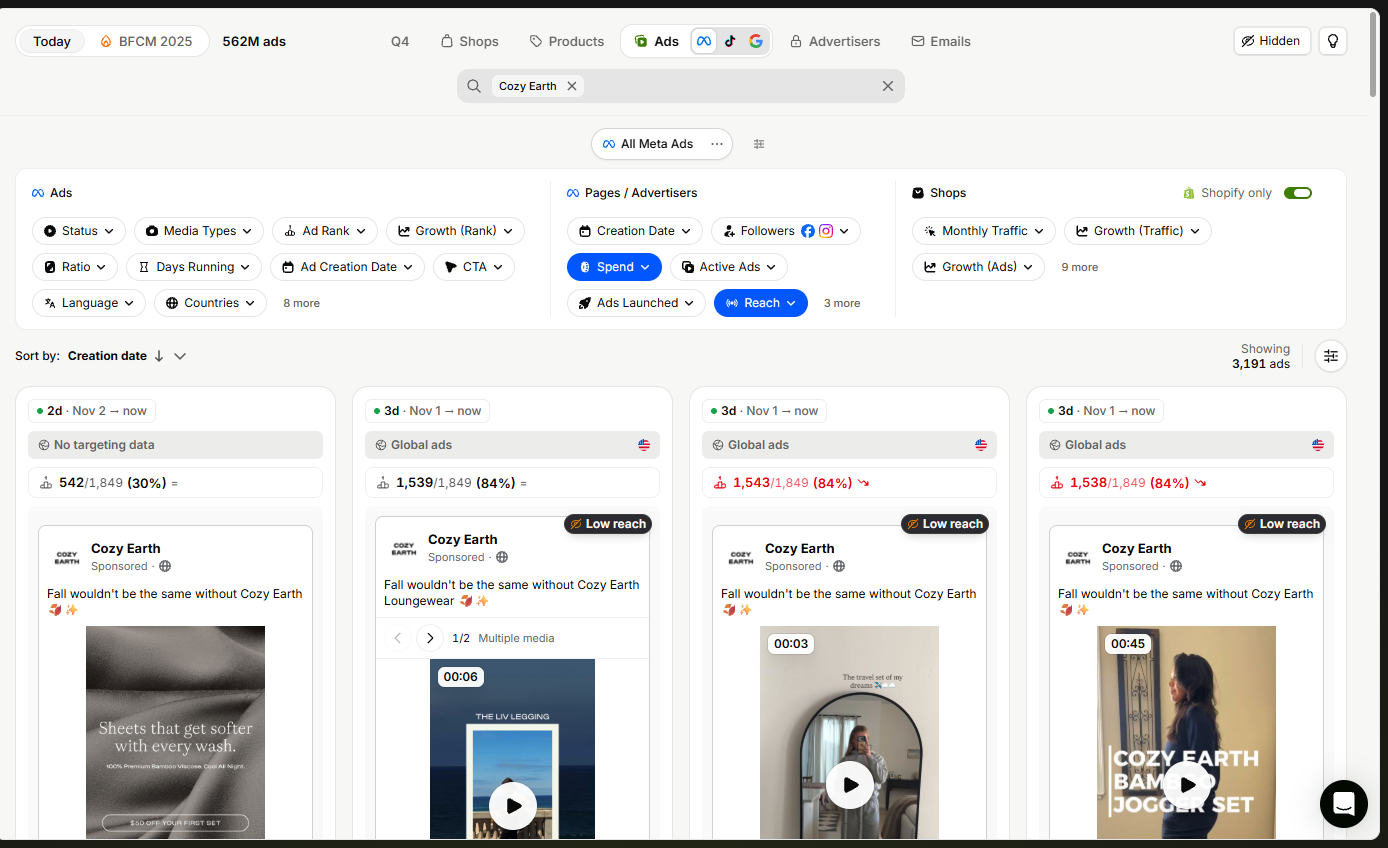
TrendTrack on the Pro plan reads an advertiser as a store. For Cozy Earth it showed an estimated $9M a month in revenue, 1.5M monthly visits and 1.7K Meta ads launched in 30 days. Its ad list had 3,191 Cozy Earth ads by keyword, while its Shop filter returned none for the same store, so try both before you conclude a brand is absent. Those figures are store-level: the advertiser pages themselves need the Business plan.
The revenue figure is an estimate. Treat it as a size class, not a sales number.
Ad-level tracking: who shows dates, status and reach
Spytrend reported totals and live ads by landing domain: for Ridge 14,958 ads on record and 2,177 active, for Obvi 96 active. That is the quickest answer to whether a brand is spending now. On TikTok, ridge.com, drsquatch.com and cozyearth.com returned no rows because its TikTok domain filter matched only the exact host; searched by brand name on 19 November 2026, Dr. Squatch had 1,439 TikTok ads, all landing on intl.drsquatch.com.
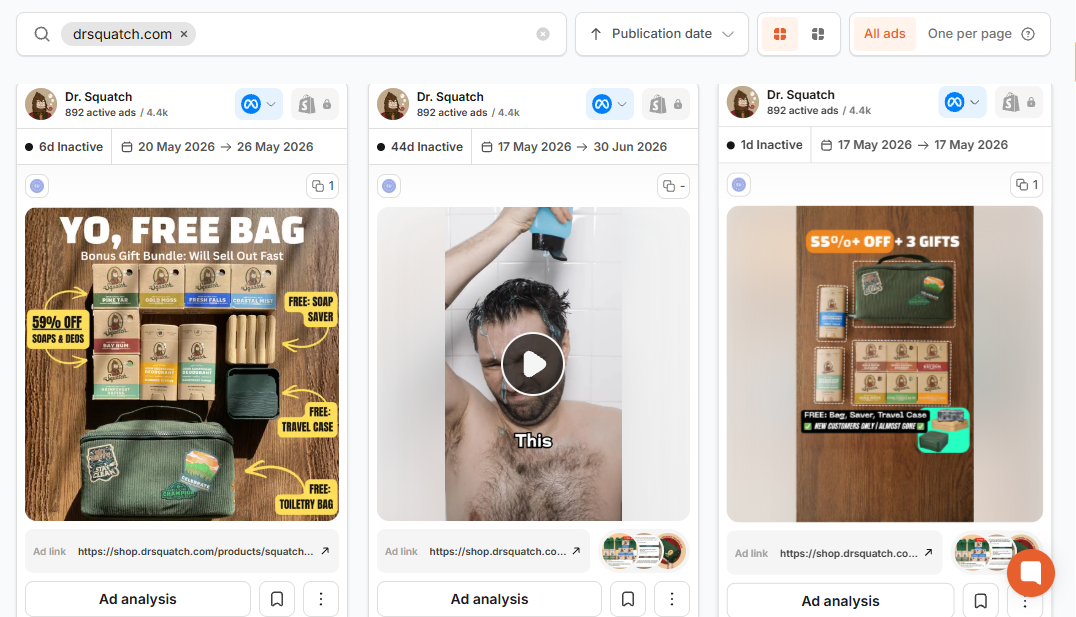
PiPiADS covers that side. On Basic each card carries dates, days and impressions, and the store view adds estimated spend and orders. Searching drsquatch.com returned 8.9K+ results in its ad search and 9.2K+ in its library view. Credits are the cost: a full search page took 20.
Minea Starter prints a live counter on each advertiser card, 892 active ads for Dr. Squatch, with start and end dates per ad. Shop visits and revenue are locked on Starter.
Archive tools: useful for copy, weak on today
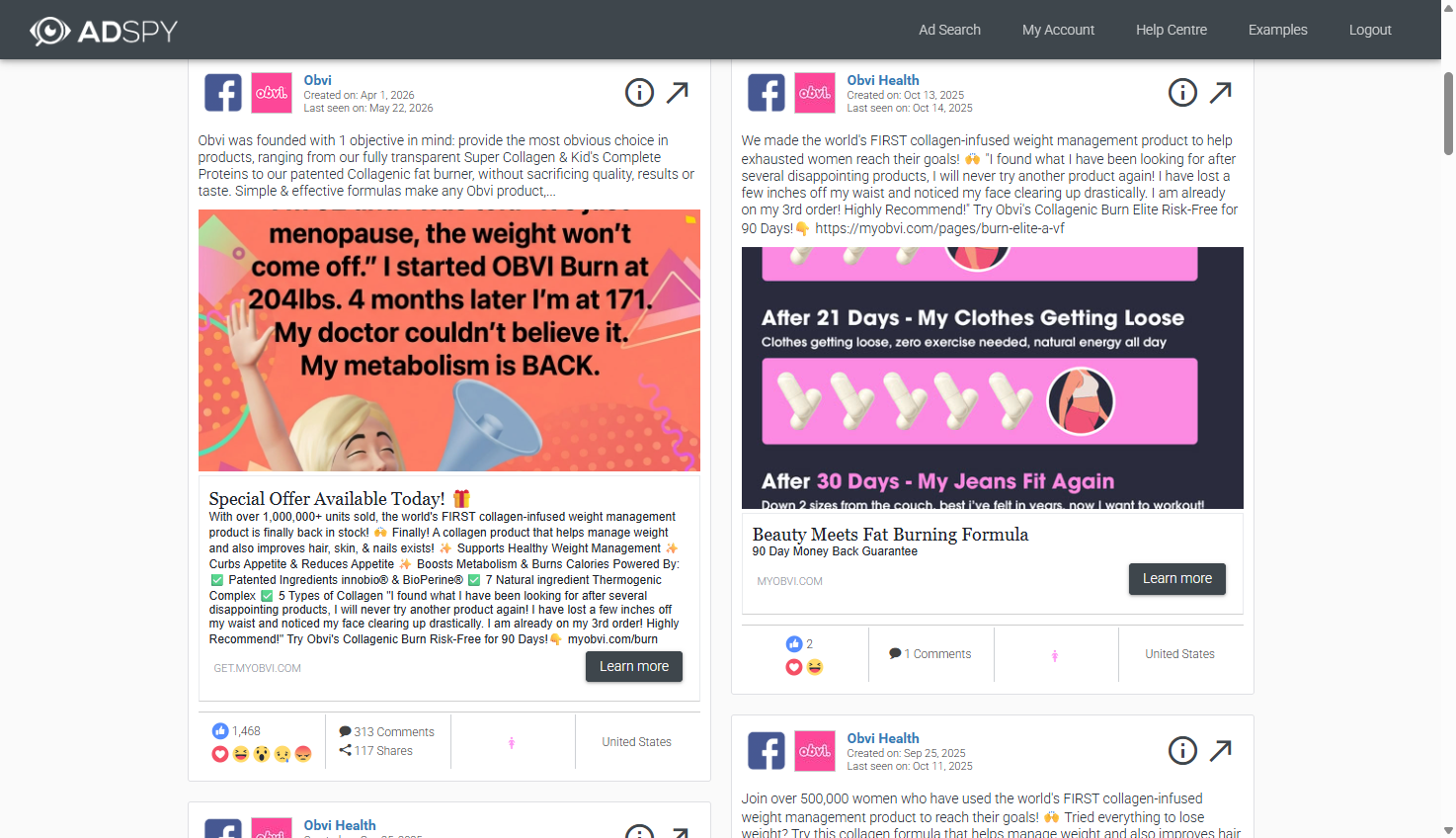
AdSpy shows Created and Last seen on each card, with reactions, comments and shares. For Obvi its newest ad by date was created on 1 April 2026 and last seen on 22 May 2026, so it told us what the brand had said, not what it runs now. There is no live counter, and comment search remains its distinct feature.
PowerAdSpy Standard gave running days and a last-seen date: 97 days and 13 October for Cozy Earth. It has no brand counter, and TikTok needs the Palladium plan. BigSpy Free showed dates for one of the four brands before limits and masked names got in the way.
Where each tool failed this test
- PiPiADS: a search page costs 20 credits, and its dates were not sorted newest first in our brand searches.
- Spytrend: its TikTok domain filter missed brands that land on a subdomain.
- TrendTrack: the Shop filter missed Cozy Earth, and advertiser pages are not on Pro.
- Minea: shop revenue and visits are locked on Starter, and TikTok is closed.
- AdSpy: no live counter, and its newest Obvi ad was months old.
None of these shows true spend. Every money figure here is a model, and we found no vendor publishing how far off it runs. If the decision depends on money, confirm it another way.
Compared head to head
Two tools at a time.
- AdSpy vs BigSpy
- BigSpy vs PowerAdSpy
- Minea vs Dropispy
- Minea vs PiPiADS
- BigSpy vs Minea
- Meta Ad Library vs BigSpy
- AdPlexity vs Anstrex
- AdSpy vs Minea
- PowerAdSpy vs AdSpy
Frequently asked questions
What does an advertising intelligence platform do?
They collect ads from platforms and add context: who runs them, when they started, whether they are live and where they lead. Some add spend, revenue or impressions estimates. Free libraries such as the Meta Ad Library cover the ads themselves for live campaigns; paid tools add history, filters and those estimates.
Do ad intelligence tools show real ad spend?
No. Spend, orders and revenue are estimates. PiPiADS shows estimated spend and orders in its store view, and TrendTrack shows estimated store revenue. Use them to compare size, not to budget against, since we found no vendor publishing an error rate for those figures.
Which ad intelligence tools cover several platforms?
Among those we checked, PiPiADS combines TikTok and Facebook on its Basic plan. TrendTrack shows Meta ads plus TikTok posts and Google entries, though its Google tab held nothing for our two test niches. PowerAdSpy lists many networks, with TikTok only on Palladium at $399 a month. Spytrend puts Facebook, Instagram and TikTok on one $79 plan without credits, though its TikTok base (380M+ ads) is smaller than its Meta one.
Can I compare ad counts between tools?
Not directly. Each tool counts its own base, removes duplicates differently and may list copies of one ad. A count is useful inside one tool over time. To compare tools, check what each one shows for the same advertiser, as we did here.
Prices come from each tool’s own site, read on 19 November 2026. Our test ran on 2026-11-04; each screenshot carries its own date.